
Source
Read-only rows from the OHPAH Raw Radio Traffic workbook. The public artifact contains aggregates only; transcripts, addresses, and source rows are never written to this repository.
Bee Ridge Road · Commercial structure fire · October 3, 2026
A commercial fire seen through its radio record. Follow the dispatch, arrival, water on fire, searches, and fire out reports below.
The artwork introduces the story. The evidence below shows what was reported, when it was reported, and how completely the record meets 47 applicable reporting benchmarks.
Open the film →Reading the data · one mark per applicable benchmark
The working transcript was checked against 47 applicable EOP reporting benchmarks. EOP means emergency operating procedure. An incomplete attempt earns credit in the current scoring model.
29 / 47 · 61.7%
Benchmarks heard at least in part.
The arcs and crossing bands express radio signals assembling into a record. Their positions and motion are artistic choices. The 47 marks here carry the counts; the timeline carries the reported sequence.
Source: Bee Ridge working transcript and EOP rescore, Revision 5, October 3, 2026. Tac 1 dispatch and Fire Tac 6 tactical traffic. The text was edited from automatic transcription; audio has not been verified. This is a provisional reporting assessment, not an official EOP determination. “Not heard” does not mean an action was not performed.
October 3, 2026 · Eastern time
Selected milestones in order. Elapsed time starts with dispatch. These are transmission times, not measured action start times.
Tac 1 dispatch sends the initial response to Bee Ridge Road and directs responding units to Tac 6.
Engine 12 reports a working fire at a two story commercial complex and announces an offensive attack.
The attack crew reports that water has been on the fire for about one or two minutes. This is the report time, not the exact start of water application.
The radio report describes the fire as under control and says overhaul is underway. Under control is a different milestone from fire out.
The second floor secondary search is reported all clear, with power secured to that division.
Decontamination at Engine 12 and rehabilitation with Rescue 9 are announced on the Alpha side.
Division Charlie reports fire out. Command repeats it four seconds later and dispatch acknowledges it nine seconds later.
49 minutes, 26 seconds from initial dispatch to the first fire out report. This is not total time on scene.
Four checks before a figure is published
the method is part of the picture
EMR Inc. · Field notes / 01
Each column is one calendar date touched by the rolling seven-day window. Height is the count of transcript-derived alert candidates.
01 / Public alert candidates
Window 2026-09-29T01:27:24-04:00 through 2026-10-06T01:27:24-04:00. Refreshed 2026-11-07T17:58:12Z.
One bar per calendar date touched by the rolling 168-hour window; the edge dates can be partial days. Transcript-derived candidates are not verified CAD incidents or confirmed responses.
Rescue 1 · saved seven-day study
A small record of a week, drawn one alert at a time. Each stem counts one transcript-derived candidate. The marks are arranged for counting.
Loading the saved study…
Open private call explorerSeptember 19–26, 2026 · 11:58:07 AM EDT at both ends. The two end dates are partial. This study is a saved snapshot; the daily research figures above use the current rolling window. Detailed timestamps and source-row links require access to the private explorer. Dear Data by Giorgia Lupi and Stefanie Posavec leads the visual reference. Missing captures may remain; these are candidates, not verified CAD incidents.
Featured incident study · Sep 20–26, 2026
Sixty-one deduplicated cardiac-arrest incidents sit beside two explicit ROSC declarations captured in radio traffic. The gap describes documentation in the available record, not clinical survival.
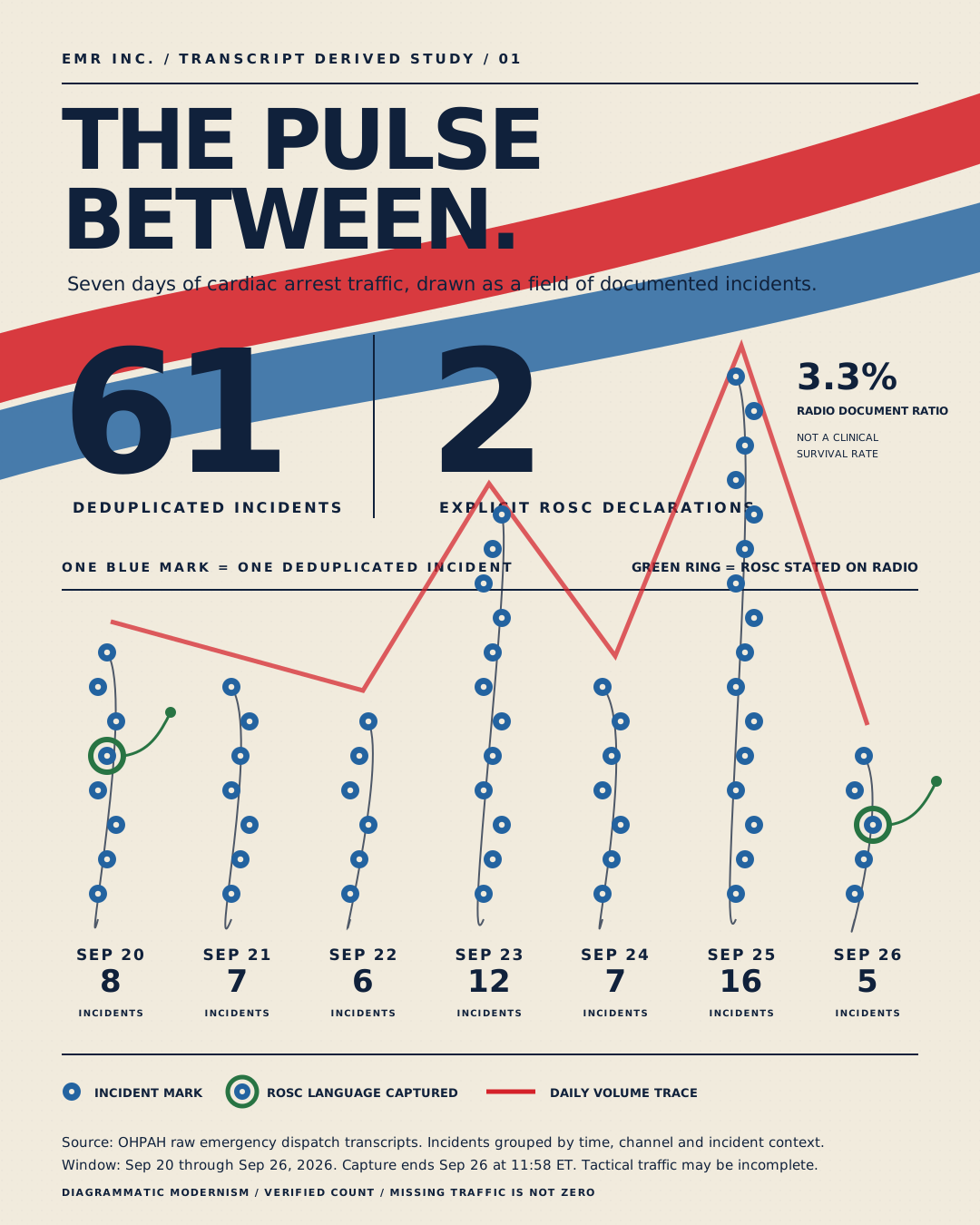
Read-only rows from the OHPAH Raw Radio Traffic workbook. The public artifact contains aggregates only; transcripts, addresses, and source rows are never written to this repository.
The file
Behind these figures is one row per dispatch transmission captured on the monitored talkgroups, with the call type, the severity, the responding unit and the time it went out. That record is not published.
It is worth being exact about why. This page publishes aggregate counts and selected incident milestones. The underlying record is row level and located to the street, and row level street located dispatch data is a different kind of disclosure from a count, no matter how careful the counts are. Radio transcripts, full addresses, coordinates and anything that identifies a member are not in it either, and have never been published anywhere on this site.
What we do publish is the method. The scripts that build these figures are readable, so how a number is computed can be checked even though the rows behind it cannot be refetched.